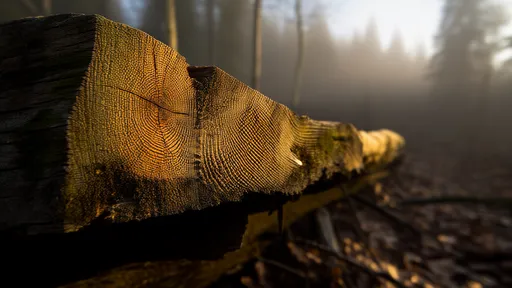
Time Imprints: The Cross-Section of Wood"
The cross-section of a tree trunk tells a story far richer than its rings might suggest. Each concentric circle, often mistaken as mere markers of age, actually encodes climatic dramas, ecological shifts, and silent battles against drought or disease. Scientists now read these arboreal archives with tools rivaling forensic technology, extracting data that rewrites our understanding of environmental history.
Dendrochronologists—those who study tree rings—no longer rely solely on manual measurements. Advanced imaging techniques like X-ray densitometry reveal hidden density variations within individual rings, exposing previously invisible stress events. A single anomalous light-colored ring might indicate a volcanic eruption thousands of miles away, its airborne particles filtering sunlight and stunting growth across continents. The 1816 "Year Without a Summer," caused by Indonesia’s Mount Tambora eruption, left its ghostly signature in trees from German oaks to Canadian pines.
Beyond climate records, these wooden time capsules harbor biochemical secrets. Mass spectrometry applied to ancient timber has detected lead pollution from Roman smelting operations and radioactive isotopes from Cold War atomic tests. The very chemistry of medieval beams in European cathedrals confirms historical trade routes, their oak isotopes matching Baltic forests documented in Hanseatic League ledgers.
The art of dendroarchaeology now dates wooden artifacts with improbable precision. A Viking longship’s planks might be traced not just to a specific decade but to the exact years when the trees were felled—sometimes revealing that repairs used timber harvested centuries later. Japanese shrines undergo similar scrutiny, their sacred pillars testifying to 8th-century logging techniques that left distinctive tool marks on ring patterns.
Modern challenges emerge as climate change distorts traditional ring patterns. Trees at alpine treelines now produce "false rings"—extra growth bands mimicking annual cycles—as warmer temperatures trigger multiple growth spurts within a single year. This phenomenon jeopardizes the very foundation of dendrochronology, forcing scientists to develop new verification methods combining isotope analysis with cellular structure examination.
Urban dendrochronology uncovers forgotten histories beneath city pavements. When New Orleans workers replaced hurricane-damaged sidewalks, researchers salvaged buried cypress logs from the 1800s. Their rings exposed previously unknown Mississippi River flood patterns, while nail holes mapped the city’s expansion—each iron spike correlating to historical property records of long-demolished houses.
The ethical dimension grows increasingly complex as studies move beyond deadwood. Living sacred trees—like Oregon’s 5,000-year-old "Prometheus" bristlecone pine controversially cut for research in 1964—spark debates about balancing scientific curiosity with ecological preservation. Indigenous communities now collaborate with laboratories, ensuring culturally significant trees are studied respectfully through non-invasive core sampling rather than full cross-sections.
Technological cross-pollination pushes boundaries further. AI pattern recognition algorithms analyze thousands of ring samples in minutes, detecting subtle correlations missed by human eyes. Meanwhile, 3D laser scanning creates digital twins of historic timber, allowing virtual "dissection" of priceless artifacts like Tudor warships or Ming Dynasty temple beams without physical damage.
Perhaps most remarkably, dendrochronology now bridges disciplines in unexpected ways. Musicologists date Stradivarius violins by matching their spruce tops’ ring patterns to Alpine tree-ring chronologies. Astronomers even consult medieval oak records to correlate solar minimum periods—when cosmic rays left carbon-14 spikes in growing wood—with historical observations of auroras and sunspots.
As we face an era of environmental uncertainty, these wooden time machines gain new urgency. The same techniques that decoded ancient droughts now monitor real-time forest stress from satellites and ground sensors. In university labs worldwide, graduate students train both microscopes and machine learning models on walnut-sized core samples, ensuring this centuries-old science continues evolving. The trees have been speaking all along; we’re finally learning to listen.