Rachmaninoff's Chord Treatment
Few musical gestures carry as much instant recognition—or as much emotional weight—as the so-called "Rachmaninoff chord." This distinctive harmonic formation, often a densely stacked minor ninth or an augmented eleventh, functions as a kind of aural fingerprint for the Russian composer. Yet to reduce it to a mere technical quirk would be to miss its profound role in shaping the soundworld of late Romanticism’s twilight years. The chord operates as both a bridge and a rupture: a bridge between Tchaikovskian pathos and early modernist dissonance, and a rupture in the very fabric of tonal harmony as it was understood in the early 20th century.
What makes this harmonic entity so potent is its paradoxical nature. At first glance, it obeys the rules of functional harmony—each note can theoretically resolve according to classical voice-leading principles. But in Rachmaninoff’s hands, these chords become suspended animations of harmonic tension, resisting resolution with almost pathological stubbornness. The opening of his Prelude in C-sharp Minor demonstrates this brilliantly: that infamous three-note motif (C-sharp, E, G-sharp) immediately gets smothered under a B in the bass, creating a minor ninth interval that vibrates with uneasy energy. This isn’t just harmony—it’s theater.
The composer’s piano concertos deploy these chords as psychological signposts. In the volcanic cadenza of the Third Piano Concerto’s first movement, the orchestra and soloist collide over a series of stacked minor ninths that don’t so much resolve as explode outward into new melodic material. Here we encounter Rachmaninoff’s true innovation: these dissonances aren’t decorative spice sprinkled atop conventional progressions, but structural pillars supporting entire musical paragraphs. The harmonic language of Ravel or Scriabin might venture further into chromaticism, but no one made dissonance feel so inevitable, so emotionally necessary, as Rachmaninoff did with these signature sonorities.
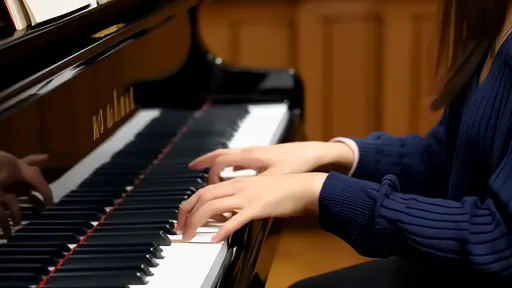
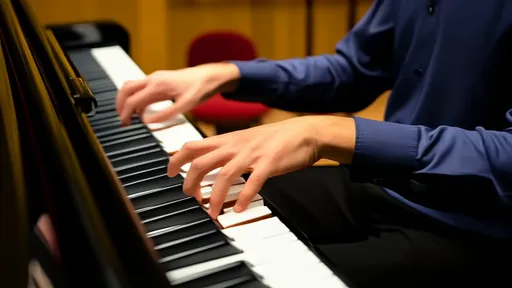
Modern analysts often note how these chords mirror the composer’s physical attributes—his legendary large hands could span intervals most pianists find impossible, allowing him to conceptualize harmonies that were literally out of reach for others. But the deeper significance lies in how these sonorities became vessels for a very particular kind of Russian melancholy. Unlike the abstract angst of Schoenberg’s emerging atonality or the impressionistic haze of Debussy, Rachmaninoff’s dissonances always feel intensely personal—like pages torn from a diary set to music. The famous opening chord of his Second Symphony’s third movement (a minor seventh with added sixth) doesn’t just "sound pretty"—it aches.
As the 20th century progressed and musical tastes shifted toward greater austerity, these lush harmonies came to represent everything the avant-garde rebelled against. Yet their influence quietly permeated unexpected places: jazz musicians adopted their rich extensions, film composers recycled their emotional immediacy, and even progressive rock bands channeled their dramatic impact. The Rachmaninoff chord became less a period-specific mannerism than a timeless tool for conveying complex emotions that words fail to capture.
Perhaps the ultimate testament to these harmonies’ power lies in their recognizability beyond classical circles. Play that C-sharp minor Prelude’s opening for any moderately musically literate person, and chances are they’ll identify it within seconds—not because they know the piece’s name, but because those stacked intervals create an atmosphere so distinctive it borders on synesthetic. The chord doesn’t just reside in the realm of pitch and vibration; it evokes physical sensations of weight, of shadows lengthening, of some profound interior struggle made audible.
In an era where much contemporary classical music has retreated into academic abstraction or minimalist repetition, revisiting Rachmaninoff’s harmonic language feels particularly poignant. Those dense chords—once considered dangerously modern—now strike us as the last glorious flowering of Romanticism’s expressive potential. They remind us that dissonance need not be merely provocative, that complexity can serve emotional directness rather than obscure it. The Rachmaninoff chord endures not as a historical curiosity, but as proof that certain combinations of notes can, in the right hands, become something akin to soul geometry—mathematical relationships that somehow map the contours of human longing.