Russian School's Dynamic Handling
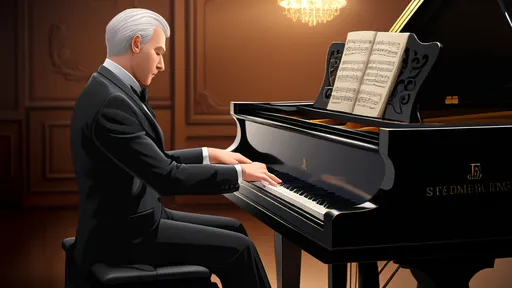
The Russian school of piano playing has long been revered for its distinctive approach to dynamic control, a tradition rooted in the meticulous balance between technical precision and emotional depth. Unlike Western interpretations that often prioritize clarity and evenness, the Russian method embraces a more fluid, sometimes volatile relationship with volume and intensity. This philosophy stems from the 19th-century lineage of Anton Rubinstein and later perfected by pedagogues like Heinrich Neuhaus, who treated dynamics not as mere notations but as living elements of musical storytelling.
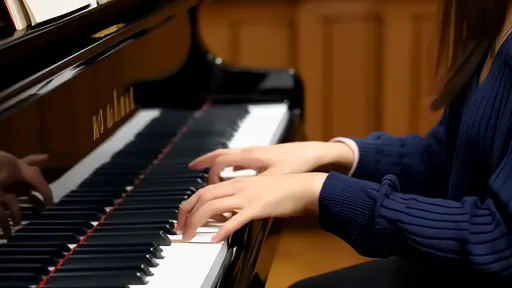
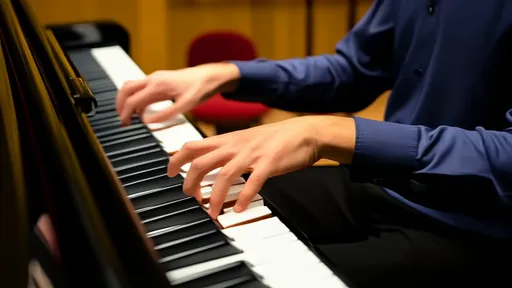
At the core of the Russian school’s dynamic philosophy lies the concept of "звуковая перспектива" (zvukovaya perspektiva), or "sound perspective." This principle treats the piano as an orchestral entity, where each finger becomes an instrument capable of independent voicing. The pianist must cultivate an acute awareness of how individual notes interact within chords, creating illusions of spatial depth. For instance, a melody might emerge not simply through louder playing but by subtly muting surrounding harmonies—a technique akin to chiaroscuro in painting. This demands an almost anatomical control over key descent, where the speed and weight of each finger are calibrated to millimeter precision.
Rubinstein’s legendary "orchestral" touch finds its modern manifestation in the works of Sviatoslav Richter, whose recordings reveal how radical dynamic shifts can become structural pillars rather than decorative effects. In Rachmaninoff’s Prelude in G Minor, Richter doesn’t merely alternate between piano and forte; he engineers seismic eruptions where crescendos seem to originate from within the instrument’s belly, achieved through a complex choreography of forearm rotation and pedal alchemy. Such approaches require redefining physicality—what Western methods might dismiss as "excessive" arm weight becomes, in the Russian tradition, essential for accessing the piano’s subterranean resonances.
The pedagogical rigor behind these techniques reveals itself in Neuhaus’s insistence on "singing fingers". Students at the Moscow Conservatory would spend months practicing scales with dynamic curves that mimicked vocal vibrato, training their hands to replicate the human voice’s natural imperfections. This organic approach stands in stark contrast to metronomic exercises, instead favoring what Gilels described as "controlled asymmetry"—a deliberate unevenness that breathes life into passages. Paradoxically, achieving such expressive freedom demands almost scientific discipline; Rachmaninoff reportedly practiced Chopin’s softest nocturnes with a coin balanced on his wrist to prevent extraneous movement.
Contemporary applications of these principles face unique challenges in an era favoring digital perfection. Young pianists like Daniil Trifonov, however, prove the tradition’s vitality by merging Russian dynamism with 21st-century aesthetics. His performance of Scriabin’s Sonata No. 5 demonstrates how micro-variations in touch—some keys depressed to 90% depth while others graze at 30%—can conjure hallucinatory textures. Such artistry underscores the Russian school’s enduring truth: that true dynamic mastery lies not in volume alone, but in the alchemical transformation of physical motion into emotional electricity.
Behind the virtuosic displays lies a philosophical framework where dynamics serve as metaphysical bridges. The St. Petersburg school, particularly through Maria Yudina’s influence, treated silent pauses and explosive sforzandi as spiritual markers rather than technical devices. This explains why Russian-trained pianists often risk apparent "imperfections"—a sudden whisper amidst fortissimo, or a delayed bass note—to reveal music’s latent drama. In an age of sanitized recordings, such fearless musicality reminds us that dynamics, in their highest form, are not about control but the sublime surrender to sound’s primal power.