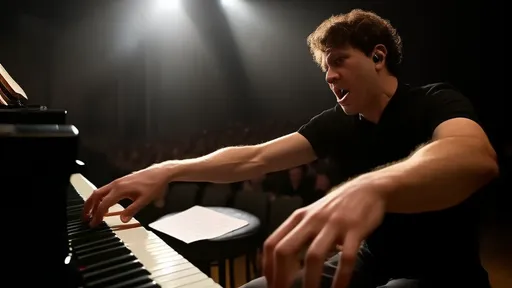
Technical Difficulties in Chopin's Etudes
The technical demands of Chopin’s Études place them among the most challenging works in the piano repertoire. Each of these twenty-seven pieces is a masterclass in combining artistic expression with virtuosic difficulty. Unlike many technical studies that prioritize mechanical repetition, Chopin’s Études are poetic and musically rich, requiring the pianist to navigate intricate passages while maintaining lyrical phrasing and emotional depth. The left-hand arpeggios in Op. 10, No. 1, for instance, demand not only agility but also a singing tone, transforming what could be a dry exercise into a flowing, harmonic journey.
The right-hand figurations in the "Revolutionary" Étude (Op. 10, No. 12) present another layer of complexity. Here, the pianist must articulate rapid, turbulent runs in the right hand while the left hand carries the weight of the melodic and harmonic structure. The challenge lies in balancing these elements—too much emphasis on the right hand’s fury can obscure the left hand’s revolutionary fervor, while neglecting the right hand’s precision can render the piece rhythmically unstable. This duality is emblematic of Chopin’s approach: technical hurdles are never merely technical; they are inextricably tied to the music’s emotional core.
One of the most notorious technical obstacles in the Études is the stretching and contraction of the hand required in pieces like Op. 10, No. 2 ("Chromatique"). The relentless semitone passages demand impeccable finger independence and a relaxed hand posture, as tension can quickly lead to fatigue or injury. Pianists often spend months, if not years, refining their technique to navigate these chromatic runs with both speed and clarity. The piece is a test of endurance as much as dexterity, pushing the limits of what the human hand can achieve.
In contrast, the "Black Key" Étude (Op. 10, No. 5) challenges the pianist’s sense of touch and articulation. Played entirely on the black keys, the piece requires a light, sparkling precision to avoid a harsh or percussive sound. The right hand’s rapid, staccato-like motions must be executed with effortless grace, while the left hand provides a steady, harmonic foundation. Misjudging the balance here can turn the étude into a series of disjointed notes rather than the playful, whimsical dance Chopin intended.
The double-note passages in Op. 25, No. 6 ("Thirds") introduce yet another dimension of difficulty. Playing thirds at high speed with evenness and clarity is a feat few pianists master. The physical constraints of the hand—fitting fingers into tight spaces while maintaining a legato line—make this étude a relentless technical crucible. Moreover, the musicality of the piece demands that these thirds not sound mechanical; they must sing, with each pair of notes voiced as part of a larger melodic arc.
Chopin’s Études also explore the limits of polyrhythms and syncopation, as seen in Op. 25, No. 11 ("Winter Wind"). The right hand’s swirling, tempestuous figurations must align precisely with the left hand’s steady pulse, creating a sense of stormy turbulence. The pianist must cultivate an acute internal metronome to prevent the two hands from drifting apart, all while conveying the piece’s dramatic intensity. It’s a reminder that Chopin’s technical demands are never divorced from the music’s expressive needs.
Ultimately, the Études are a testament to Chopin’s genius in merging technical innovation with profound musicality. They are not just studies in finger dexterity but explorations of the piano’s poetic potential. Mastering them requires more than physical prowess; it demands an artistic sensitivity that breathes life into every note, turning technical challenges into moments of transcendent beauty.