Relaxation Techniques for Piano Octaves

Jul 25, 2025 By

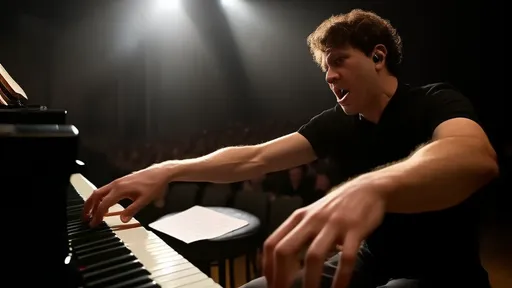
Mastering the art of playing octaves on the piano requires not only precision and strength but also a deep understanding of relaxation techniques. Many pianists, especially those in the early stages of their development, struggle with tension when executing octave passages. This tension often leads to fatigue, unevenness, and even injury over time. The key to fluid and effortless octave playing lies in cultivating a balanced approach that combines controlled power with deliberate relaxation.

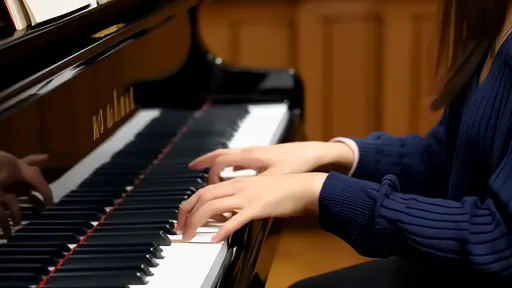
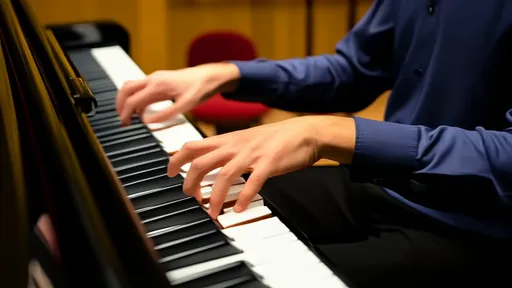
The foundation of relaxed octave playing begins with proper hand positioning. The hand should form a natural arch, with the thumb and fifth finger gently curved to strike the keys. A common mistake is stretching the fingers too flat or collapsing the knuckles, both of which create unnecessary tension. Instead, imagine holding a small ball in your palm—this mental image helps maintain the hand's structure without stiffness. The wrist should remain flexible, acting as a shock absorber rather than a rigid bridge between the arm and fingers.

Arm weight plays a crucial role in achieving relaxed octaves. Rather than relying solely on finger strength, skilled pianists use the forearm's natural weight to produce sound. This approach reduces strain on the smaller muscles of the hand while creating a fuller, more resonant tone. When playing consecutive octaves, think of the arm as a pendulum, with the elbow leading slight lateral motions. This fluid movement prevents the buildup of tension that occurs when the arm remains static while the fingers work overtime.

Breathing is an often overlooked but vital component of relaxation technique. Many pianists unconsciously hold their breath during challenging octave passages, which immediately increases tension throughout the upper body. Conscious, rhythmic breathing helps maintain relaxation—inhale during moments of preparation or release, and exhale during moments of exertion. This practice not only reduces physical tension but also helps maintain musical phrasing and expression.

The speed of octave passages significantly impacts the ability to stay relaxed. When learning new repertoire or developing technique, always begin slowly, focusing on complete relaxation between each octave. As the motions become more familiar, gradually increase the tempo while monitoring for any signs of tension. Rushing this process inevitably leads to tight, forced playing. Remember that true speed comes from efficiency of motion, not muscular tension.

Mental focus and visualization techniques can enhance physical relaxation. Before playing, take a moment to mentally trace the path of relaxation through your body—from the shoulders down to the fingertips. Imagine the arms moving with the grace and ease of a dancer. This mental preparation often yields better results than purely physical repetition. When practicing, periodically pause to check in with your body, releasing any accumulated tension before continuing.

The choice of repertoire and practice methods greatly influences the development of relaxed octave technique. Select studies and pieces that progressively challenge your octave playing without causing strain. Burgmüller's "L'Orage" or Chopin's "Military" Polonaise offer excellent material for developing controlled octave playing. When practicing, isolate octave passages and work on them with various rhythms and articulations to build both control and flexibility.

Physical conditioning outside of piano practice can support relaxed octave playing. Gentle stretching exercises for the hands, wrists, and forearms help maintain flexibility. Yoga or Pilates can improve overall body awareness and posture, which directly affects playing comfort. However, avoid excessive strength training that might lead to muscle tightness—piano technique relies more on coordination and efficiency than raw power.

Listening to great pianists can provide invaluable insights into relaxed octave playing. Notice how the masters like Rubinstein or Argerich create powerful octave sounds without apparent effort. Their secret often lies in perfect timing—the precise coordination between key descent and arm weight application. Record yourself regularly to develop this same awareness of your own sound production and physical approach.

The journey to effortless octave playing is one of patience and mindful practice. By prioritizing relaxation as much as accuracy, pianists discover that technical challenges become musical opportunities. Over time, what once required conscious effort transforms into second nature, allowing the performer to focus entirely on musical expression. The true mastery of octave technique isn't measured by speed or volume alone, but by the ability to produce beautiful music with physical ease and artistic freedom.
Recommend Posts
Music

Tone Correction for Beginners Learning Violin

By /Jul 25, 2025

Learning to play the violin is a journey filled with both excitement and challenges. Among the many hurdles beginners face, achieving proper intonation—or playing in tune—is one of the most critical yet difficult skills to master. Unlike fretted instruments, the violin requires precise finger placement to produce accurate pitches, making ear training and muscle memory essential components of early practice. For those just starting, the process of correcting pitch can feel overwhelming, but with patience and the right techniques, it becomes an achievable goal.
Music

Bach's Unaccompanied Technical Code

By /Jul 25, 2025

The enigma of Bach’s unaccompanied works has fascinated musicians and scholars for centuries. These compositions, particularly the sonatas and partitas for solo violin and the cello suites, are often regarded as the pinnacle of technical and artistic achievement in Western classical music. Yet, beneath their sublime beauty lies a labyrinth of technical challenges that demand not only virtuosic skill but also profound interpretive insight. To unlock the secrets of these works is to engage with a musical language that transcends mere notes on a page.
Music

Bass Figured Bass Performance Standards

By /Jul 25, 2025

Figured bass, also known as thoroughbass or basso continuo, represents one of the most distinctive features of Baroque music. This system of musical shorthand provided performers with a framework for improvisation while allowing composers to outline harmonic progressions without specifying every note. The practice of realizing figured bass requires not only technical skill but also a deep understanding of historical conventions and stylistic nuances.
Music

Rachmaninoff's Chord Treatment

By /Jul 25, 2025

Few musical gestures carry as much instant recognition—or as much emotional weight—as the so-called "Rachmaninoff chord." This distinctive harmonic formation, often a densely stacked minor ninth or an augmented eleventh, functions as a kind of aural fingerprint for the Russian composer. Yet to reduce it to a mere technical quirk would be to miss its profound role in shaping the soundworld of late Romanticism’s twilight years. The chord operates as both a bridge and a rupture: a bridge between Tchaikovskian pathos and early modernist dissonance, and a rupture in the very fabric of tonal harmony as it was understood in the early 20th century.
Music

Russian School's Dynamic Handling

By /Jul 25, 2025

The Russian school of piano playing has long been revered for its distinctive approach to dynamic control, a tradition rooted in the meticulous balance between technical precision and emotional depth. Unlike Western interpretations that often prioritize clarity and evenness, the Russian method embraces a more fluid, sometimes volatile relationship with volume and intensity. This philosophy stems from the 19th-century lineage of Anton Rubinstein and later perfected by pedagogues like Heinrich Neuhaus, who treated dynamics not as mere notations but as living elements of musical storytelling.
Music

Relaxation Techniques for Piano Octaves

By /Jul 25, 2025

Mastering the art of playing octaves on the piano requires not only precision and strength but also a deep understanding of relaxation techniques. Many pianists, especially those in the early stages of their development, struggle with tension when executing octave passages. This tension often leads to fatigue, unevenness, and even injury over time. The key to fluid and effortless octave playing lies in cultivating a balanced approach that combines controlled power with deliberate relaxation.
Music

Interpretation of Special Notation in Modern Notation

By /Jul 25, 2025

Modern musical notation is a complex language that extends far beyond the basic staff, clefs, and notes. Among its most intriguing aspects are the special symbols that provide performers with nuanced instructions on how to interpret a piece. These symbols, often overlooked by casual readers, serve as the composer’s direct communication with the musician, offering insights into articulation, dynamics, and expression. Understanding them is essential for any serious musician aiming to deliver an authentic performance.
Music

The Historical Evolution and Differences of Ornamentation

By /Jul 25, 2025

The history of ornamental notes in music is a fascinating journey through time, reflecting the evolving tastes, techniques, and cultural contexts of different eras. From the elaborate flourishes of the Baroque period to the restrained elegance of the Classical era, and the expressive freedom of the Romantic age, ornamentation has always been a vital element of musical expression. Its interpretation and execution have varied widely, shaped by the stylistic conventions and performance practices of each epoch.
Music

Differences in Touch Techniques of the German-Austrian Piano School

By /Jul 25, 2025

The distinction between the German and Austrian piano schools, particularly in their approaches to touch and tone production, remains a fascinating subject for pianists and musicologists alike. While both traditions share common roots in the Central European classical tradition, their nuanced differences in technique and philosophy have shaped generations of performers. These variations extend beyond mere stylistic preferences, reflecting deeper cultural and pedagogical divergences that continue to influence piano playing today.
Music

Rhythm Restoration in Chinese Gugong Music Notation

By /Jul 25, 2025

The ancient Chinese musical notation system known as Gongchepu has long fascinated scholars and musicians alike. Unlike Western notation, which relies on a staff and clefs, Gongchepu uses Chinese characters to represent pitch and employs a unique set of symbols to indicate rhythm. The system, which dates back to the Tang Dynasty, was widely used in traditional Chinese opera and ensemble music. Today, there is a growing interest in reconstructing and performing music based on Gongchepu manuscripts, a process that involves deciphering its rhythmic codes to bring centuries-old compositions back to life.
Music

Technical Difficulties in Chopin's Etudes

By /Jul 25, 2025

The technical demands of Chopin’s Études place them among the most challenging works in the piano repertoire. Each of these twenty-seven pieces is a masterclass in combining artistic expression with virtuosic difficulty. Unlike many technical studies that prioritize mechanical repetition, Chopin’s Études are poetic and musically rich, requiring the pianist to navigate intricate passages while maintaining lyrical phrasing and emotional depth. The left-hand arpeggios in Op. 10, No. 1, for instance, demand not only agility but also a singing tone, transforming what could be a dry exercise into a flowing, harmonic journey.
Music

The Principle of Harmonic Combination in Sheng

By /Jul 25, 2025

The sheng, China's ancient mouth-blown free reed instrument, has captivated musicians and scholars for centuries with its unique polyphonic capabilities. Unlike most traditional Chinese instruments that produce single melodic lines, the sheng stands out as a harmonic instrument, capable of sounding multiple notes simultaneously. This remarkable feature places the sheng in a special category among world musical instruments and offers fascinating insights into acoustic principles that predate Western harmonic theory by millennia.
Music

Paganini Caprice Finger Technique Breakthrough

By /Jul 25, 2025

The world of violin technique has long been haunted by the ghost of Niccolò Paganini, whose 24 Caprices stand as both monument and menace to string players. For nearly two centuries, violinists have approached these works with equal parts reverence and terror, knowing they represent the ultimate proving ground for technical mastery. Now, a quiet revolution in fingering approaches is changing how musicians conquer these Everest-like études.
Music

French Violin Bowing Aesthetics

By /Jul 25, 2025

The French school of violin bowing has long been regarded as one of the most sophisticated and influential approaches in classical music. Its emphasis on elegance, precision, and tonal beauty has shaped the way violinists interpret everything from Baroque sonatas to Romantic concertos. Unlike the more forceful German tradition or the virtuosic Russian style, the French bowing technique prioritizes a seamless connection between notes, a refined articulation, and a delicate balance between expressiveness and restraint.
Music

Reconfiguration of Jazz Harmony

By /Jul 25, 2025

The art of reharmonization in jazz is a fascinating journey through harmonic possibilities, where familiar melodies take on new colors and unexpected twists. Unlike classical harmony's stricter rules, jazz reharmonization thrives on spontaneity, personal expression, and a deep understanding of chord substitutions. It’s not merely about replacing chords but reshaping the emotional landscape of a piece while respecting its original intent. Musicians often describe it as "telling the same story in a different dialect," where the melody remains recognizable, but the harmonic backdrop transforms it into something fresh and exciting.
Music

Liszt's Super-Technique Physical Energy Distribution

By /Jul 25, 2025

Franz Liszt’s Transcendental Études stand as a monumental challenge in the piano repertoire, demanding not only technical mastery but also exceptional physical endurance. The sheer intensity and complexity of these works require a carefully considered approach to energy distribution, as the pianist must sustain both precision and expressiveness across extended passages of virtuosic difficulty. Unlike many other compositions, where technical demands are interspersed with moments of respite, Liszt’s études often push the performer to their physical limits, making strategic stamina management a critical component of successful interpretation.
Music

Italian Bel Canto Breathing Tradition

By /Jul 25, 2025

The Italian bel canto tradition, with its emphasis on seamless vocal production and expressive phrasing, remains one of the most revered schools of singing in classical music. At its core lies a sophisticated approach to breathing—a technique so refined that it transforms the human voice into an instrument of unparalleled beauty. For centuries, this method has been passed down through generations of singers, each adding their own nuances while preserving the foundational principles established during the Baroque and early Romantic periods.
Music

Beethoven's Manuscript: Intentions Behind the Revisions

By /Jul 25, 2025

The study of Beethoven's manuscripts offers a rare glimpse into the mind of a musical genius. His handwritten scores, filled with corrections, revisions, and sometimes furious scribbles, reveal a composer deeply engaged in the process of creation. Unlike the polished final versions we hear in concert halls, these drafts show the raw, unfiltered struggle behind the music. Scholars and musicians have long been fascinated by the intentions behind these changes, as they provide invaluable insights into Beethoven's creative process.